
AVWAP Course: Initiation Retest Lesson I
November 18, S&P500 (ES)
Each week I review key moments from recent price action in the indices. These instances will be analyzed using three methods: the tape / DOM; footprint; and candle chart. Synthesizing the three allows an understanding greater than the sum of its parts, leading to a complete understanding of the auction process. While there are many great resources out there, I am not aware of any that provide such a comprehensive study guide.
This mini-lesson is the first of a longer series using the anchored volume-weighted average price (AVWAP). Most trading platforms have this feature. It does not make a difference what timeframe or chart type as volume and price are independent of time. The following lesson will share some helpful strategies for using the AVWAP to identify potential entries (and exits).
Anchor Type: Initiation
The art of using the AVWAP is based on the anchor point. While a random point may have some immediate utility, there is simply too much noise and indecision to make for the most stress-free read of the price action using this tool. So it is best to be judicious - and wait for the market to come to a price you’ve negotiated in advance.
Not all points are created equal. That is what this new series of lessons is intended to teach.
There are three main points I use for AVWAP: trend days, initiation (event days are a variant), and finally, pass-off AVWAPs. I credit Brian Shannon for much of his work developing AVWAPs, and all credit to his ‘pass-off’ strategy.
Buy and sell programs in the market often use an intraday VWAP to engage off the best possible price, especially during trend days. It is important to identify the anchor point early and within the right context.
Compare the two potential anchor points below from today’s action.
Image 1. VWAP anchored to the RTH open, ES 500 trade tick chart
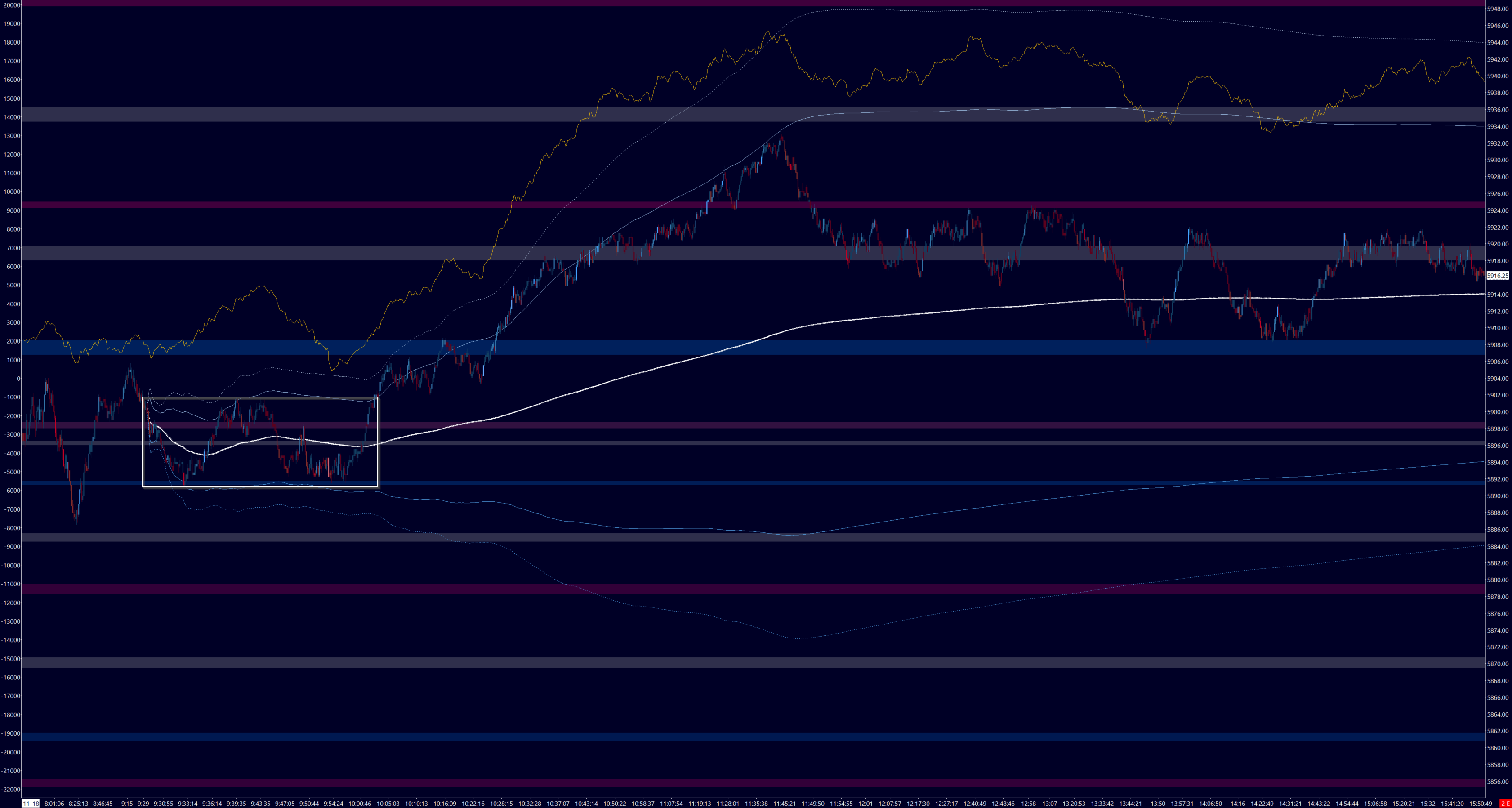
The image above anchors to the opening candle of the RTH session. Note the white box highlighting the two-way auction at the open - large accounts positioning ahead of the session.
It is best to avoid getting cut up during this time, waiting to join the larger fish once it is clear a direction has been chosen. If not - sit out entirely.
This is why I am usually OK to sit out the first 15m or more of trade unless I have a high conviction otherwise, for example information in the pre-cash session.
Let’s look at a better option below!