
AVWAP Course: Exhaustion Lesson III
January 10, S&P500 (ES)
Each week I review key moments from recent price action in the indices. These instances will be analyzed using three methods: the tape / DOM; footprint; and candle chart. Synthesizing the three allows an understanding greater than the sum of its parts, leading to a complete understanding of the auction process. While there are many great resources out there, I am not aware of any that provide such a comprehensive study guide.
This lesson is part of a longer series using the anchored volume-weighted average price (AVWAP). Most trading platforms have this feature. It does not make a difference what timeframe or chart type as volume and price are independent of time. The following lesson will share some helpful strategies for using the AVWAP to identify potential entries (and exits).
Anchor Type: Exhaustion
As I have written before, the art of using the AVWAP is based on choosing the proper anchor point. Much of this is context driven - sometimes it is as simple as a local bottom or top, other times it is taken from the entrance of a large player on the tape.
This lesson will focus on using an exhaustion high as an anchor and considering context - to practice patience and refine your entry. The nuance here is the initiation into new highs (or lows) which is swiftly rejected. Volume then immediately shuts off as the initial direction of trade unwinds.
This will often appear as a gravestone doji in a candle chart. Remember this formation - the inverse (hammer candle) also applies with excess into the lows.
Image 1. Gravestone doji
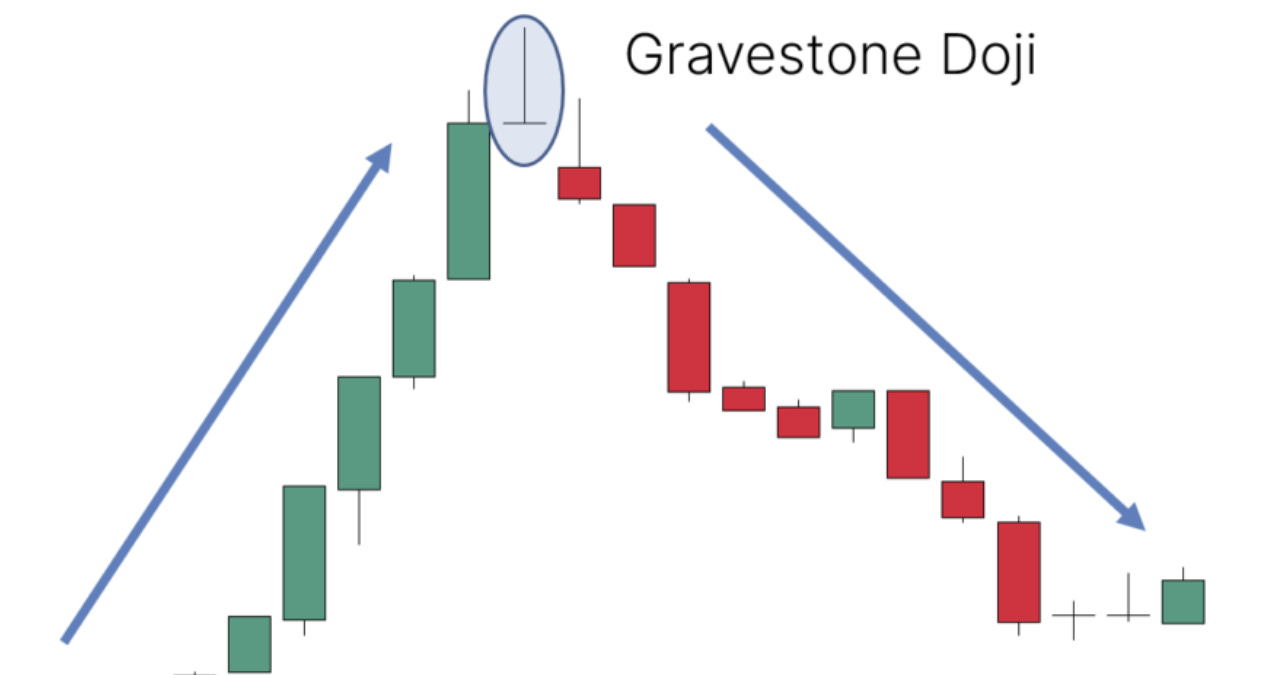
This ‘classic’ anchor to a high is more straightforward than other anchored VWAPs we have studied to date, for example initiation or event-driven. Many traders will appreciate the unequivocal context (of a local high or low) - which eliminates some guesswork.
The key now is to use context around AVWAP retests to determine the location of an entry (short, in our case). Let’s take a look at four very different sets of contextual information, and the trade opportunities around them.
Keep in mind that even though the following four examples take place over roughly the course of an hour pre-market to A period, these concepts are applicable intraday - or intraweek - as well.
Image 2. VWAP anchored to pre-cash open high
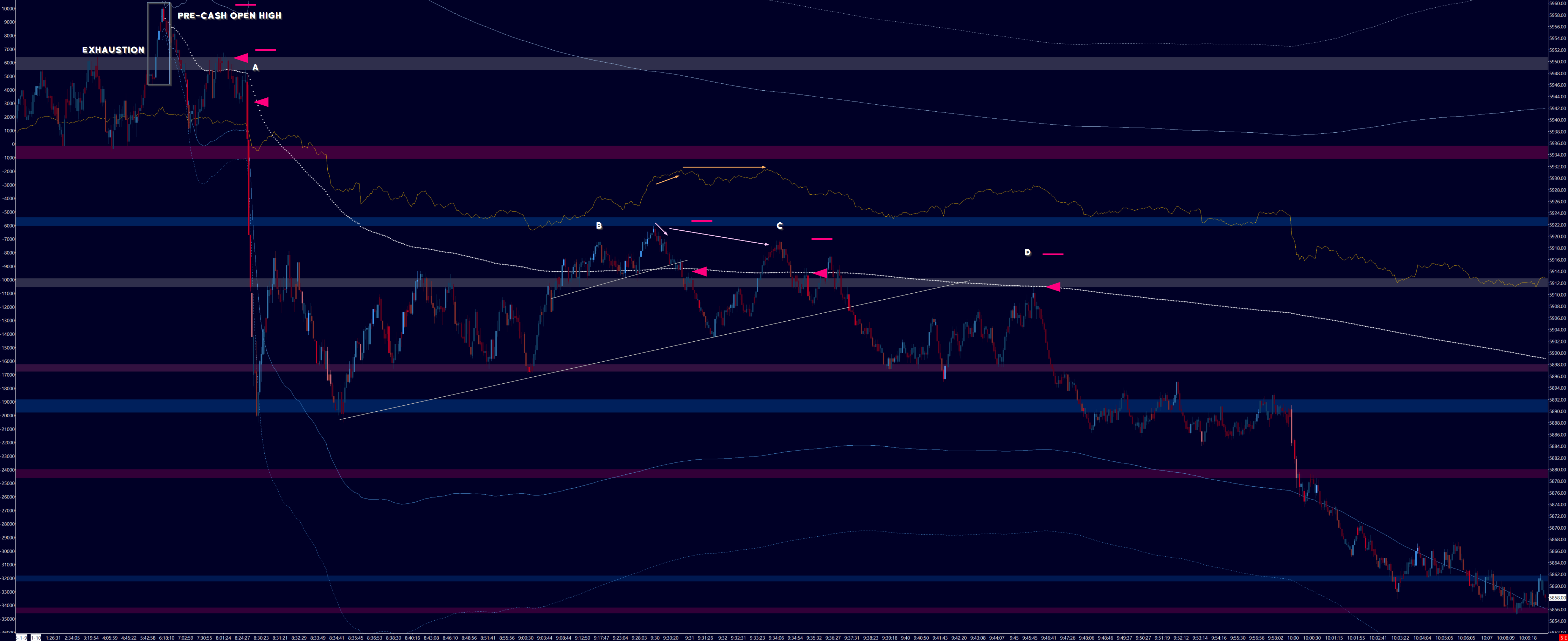
A. ABSORPTION AT AVWAP.
It should be very clear by now how we set this AVWAP. Another option is to use the overnight high (ONH) as in Image 3 below. This is also an ‘unequivocal’ VWAP anchor point, and works well at our pre-cash open exhaustion location, as seen in our image below.
Image 3. VWAP anchored to ONH
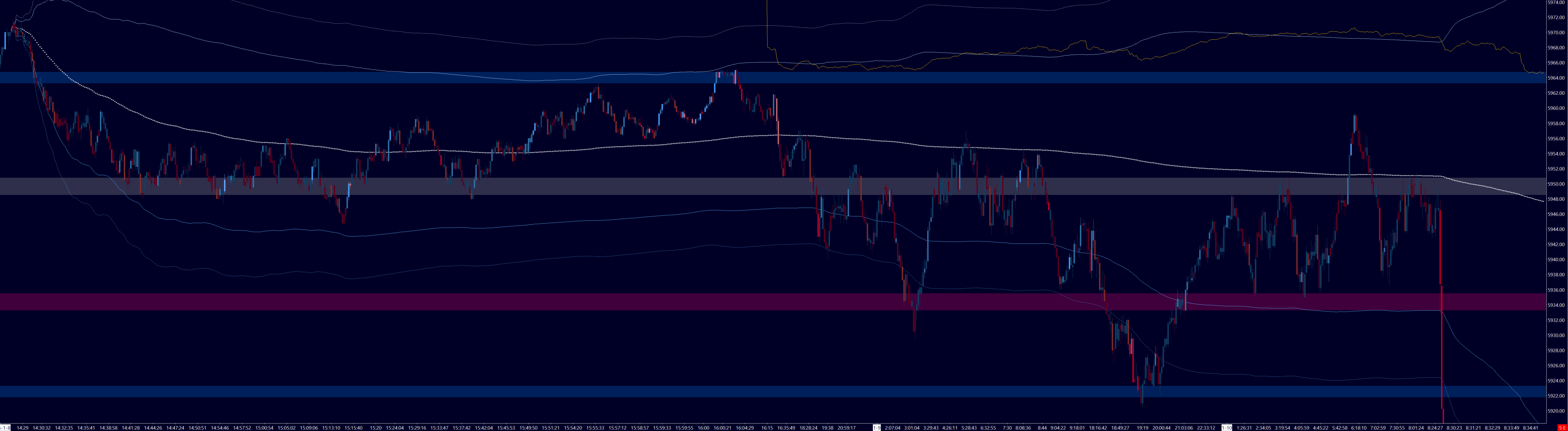
Indeed, this anchor point might suggest the better entry location with a stop against the exhaustion high. But let’s not sweat between 50,000 or so contracts in the overnight (ON) session. Choosing the pre-cash exhaustion anchor point as opposed to the ONH may simply give you a more reactive AVWAP earlier in the session.